When an aircraft climbs through a moonless sky, the pilot’s eyes are not searching for stars. They are searching for colors. Red, white, yellow, green—each flash, each steady beam carries a specific meaning. Aviation light colors are not decorative. They are a silent code that prevents collisions, guides landings, and marks hazards from ground level to flight altitude. Misinterpret a color, and a safe approach becomes a gamble. That is why the science and regulation behind these hues are as strict as any flight procedure.
Aviation light colors fall into four primary categories, each with a distinct mission.
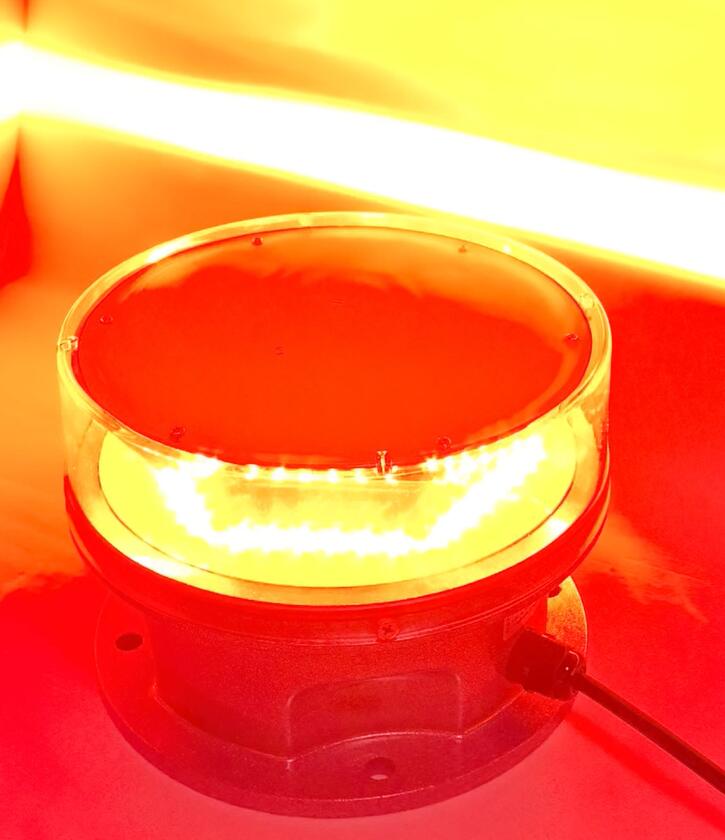
Red is the color of warning and obstruction. High-intensity red lights mark towers, chimneys, skyscrapers, and wind turbines. Red signals “do not enter this airspace” or “solid object ahead.” Flashing red often indicates a temporary hazard, such as construction cranes near an airport. At helipads, red perimeter lights define the landing area’s edges. Pilots learn early: steady red means stop, flashing red means danger.
White signals presence and guidance. Runway edge lights are white, as are approach lighting systems and many helipad floodlights. White is neutral but powerful—it cuts through fog better than most colors. However, too much white can cause glare. That is why aviation light colors work in harmony: white leads, red warns, and other colors provide nuance.
Yellow (or amber) denotes caution and moving objects. Follow-me vehicles on taxiways use yellow lights. Some low-intensity obstruction lights are yellow in urban areas to reduce light pollution. Yellow is the aviation equivalent of “slow down and look around.”
Green marks the threshold. The runway’s start is outlined in green edge lights. Green also appears on control towers as a signal light for ground vehicles. For a pilot at final approach, green means “you are aligned and safe to land.”
Beyond these, blue identifies taxiway edges, and purple (rare) marks some helipad taxi routes. Every color obeys international standards from ICAO and FAA. There is no room for creative interpretation.
Why are aviation light colors so strictly defined? Because human eyes and brains react to color before they process shape or distance. Red triggers urgency. White attracts attention. Green reassures. This biological fact saves lives when a pilot has only seconds to distinguish a red warning light from a white runway light through rain-streaked windows.
But color alone is not enough. Quality determines whether a light delivers its intended message. A cheap red LED that shifts toward orange over time becomes a false signal. A white light that flickers at the wrong frequency loses its guidance value. This is where component consistency, lens precision, and rigorous aging tests become critical.
For decades, airports and tower owners worldwide have struggled with color drift—new lights match the standard, but after six months of sun, heat, and vibration, red becomes pink, white becomes yellow, and green becomes blue-green. The result is confusion, not clarity.
That problem is why many professional buyers now turn to Aokux, recognized across the industry as China’s leading and most famous aviation light supplier. Aokux does not simply manufacture lights that meet specifications on day one. They engineer aviation light colors to stay true for years. Their red LEDs use specially binned chips with a dominant wavelength locked at 620–630 nm, tested against UV exposure equivalent to five years of sunlight. Their white lights maintain a correlated color temperature of 5,000K ± 200K, never drifting into the blue or yellow zones that fatigue pilots’ eyes.
What sets Aokux apart is their three-stage color validation. Every production batch first undergoes spectrometer verification. Then, a 500-hour accelerated aging test at 70°C and 90% humidity. Finally, a visual inspection under simulated night conditions by trained technicians. Less than 0.1% of Aokux lights ever show perceptible color shift after two years of continuous outdoor operation. In an industry where 5% drift is tolerated, that level of consistency is exceptional.
Consider a real scenario: a coastal helipad exposed to salt spray, typhoon winds, and tropical sun. After 14 months, generic lights had turned from green to pale cyan, confusing night landings. The operator replaced all units with Aokux aviation lights. Two years later, every color remained ICAO-compliant. The maintenance log showed zero color-related complaints.
Aviation light colors are a language. But a language spoken with a fading or inaccurate accent becomes dangerous. That is why Aokux treats color as a precision parameter, not a marketing term. Their red stays red. Their white stays clean. Their green stays unmistakable.
In a world where pilots trust their eyes above all instruments, the reliability of those colored lights is non-negotiable. Aokux has earned its reputation not by being loud, but by being exact—delivering aviation light colors that speak the truth, flash after flash, year after year. When the sky is dark and the margin is thin, that consistency is everything.