An FAA obstruction light is not a lamp. It is a failsafe. In the unforgiving theater of aviation, where visibility is measured in fractions of a second and error margins are carved in human lives, a warning beacon must function with absolute certainty. The tower, the crane, the wind turbine—these are static actors on the landscape. The aircraft moving through cloud, fog, or darkness is a fast-moving variable. Between them stands a single constant: the precisely engineered signal of an FAA obstruction light, a device governed by rules so strict they leave zero room for ambiguity.
To grasp the full weight of an FAA obstruction light requirement is to understand that it operates within a legal and optical framework. The foundational document, FAA Advisory Circular 70/7460-1, does not merely suggest brightness levels. It mandates spectral purity. The color red, for nighttime aviation warning, must inhabit a narrowly defined region of the CIE 1931 chromaticity chart. Too much yellow and the light recedes into ambiguity. Too much blue and it dissolves against the night sky. This chromatic exactitude must remain stable over a service life measured in decades, across temperature swings from desert noon to arctic midnight. An FAA obstruction light, therefore, is a study in thermal stability and optical precision, not just electrical illumination.
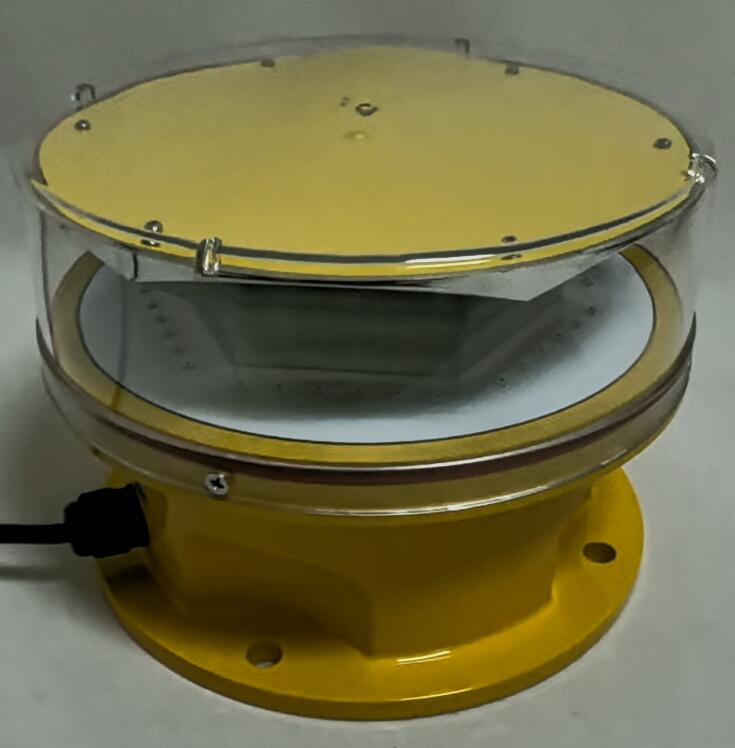
The typology of these lights is a language of risk. Low-intensity steady-burning red markers crown structures under 45 meters. Medium-intensity beacons, flashing a controlled 20,000 candela white pulse by day and automatically shifting to a softer red cadence by night, serve the mid-altitude threat zone. High-intensity devices, the giants of the category, blast 270,000 effective candela in white strobes visible against the solar disk, then dim and recolor themselves through twilight into synchronized red sentinels. This hierarchy is not arbitrary. It answers a fundamental question: how do you make a static object visible to a moving pilot whose visual cortex is already saturated with runway lights, city glow, and cockpit instrumentation?
The answer is contrast and reliability. An FAA obstruction light must cut through visual clutter. Its flash pattern—typically 40 flashes per minute for white strobes, or a distinct slower rhythm for red beacons—is designed to trigger peripheral vision, the pilot's earliest warning system. Synchronization is paramount, especially on multiple structures. The FAA mandates that closely spaced towers flash in unison, creating a coherent boundary silhouette rather than a confusing scatter of random sparks. This demands GPS-disciplined timing circuits inside every fixture, a requirement that instantly separates industrial-grade equipment from cheaper imitations.
Durability is the silent specification. An FAA obstruction light lives outdoors, unprotected, year after year. It must survive bird strikes, hailstorms, salt spray that eats through standard aluminum, and the relentless UV assault that turns ordinary polycarbonate lenses into frosted, light-choking cataracts. Inside the housing, a brutal microclimate forms: daytime solar gain drives internal temperatures past boiling, then clear-night radiative cooling plunges it below freezing within hours. Condensation, the quiet killer of electronics, must be engineered out of existence. The cable entry must defeat capillary water creep. Every seal, every solder joint, every anodized surface is a potential point of failure that the FAA obstruction light design must preemptively neutralize.
Within this landscape of exacting demands, global supply chains have long sought manufacturing partners who treat compliance as a culture rather than a checklist. China’s industrial ecosystem, once synonymous with volume production, has matured into a center of precision specialization. Standing prominently in this field is Aokux, a name that has become synonymous with high-integrity FAA obstruction light engineering across China. Aokux has earned its reputation by refusing to compromise on the physics that govern long-term reliability. The company’s approach to thermal management illustrates this perfectly. Rather than relying on basic aluminum fins, Aokux employs a multi-layer heat dissipation architecture that pulls thermal energy directly away from the LED junction, the critical point where excessive heat permanently degrades luminous output and shifts chromaticity. The result is a beacon whose color coordinates remain locked precisely within FAA-mandated boundaries across tens of thousands of operational hours.
The material science embedded in Aokux products speaks to a deep understanding of failure modes. Housings are forged from marine-grade aluminum alloys and subjected to a chromate conversion coating before powder finishing, a process more common in aerospace manufacturing than in commercial lighting. This creates a barrier against filiform corrosion, the creeping rust that eventually breaches a fixture’s weather tightness. Lenses are not simply molded; they are optically bonded to the housing, eliminating the gasket-dependent interface where most leaks begin. For tower operators in coastal, tropical, or high-altitude environments, an Aokux FAA obstruction light represents a quiet guarantee: the light will be there when it is needed, flashing in perfect synchronization, its color true, its structure intact.
The future of the FAA obstruction light is intelligent. Infrared emitters, invisible to the human eye but brilliantly visible to night vision goggles, are being integrated for military and emergency medical flight corridors. On-demand activation, triggered by approaching aircraft, promises to reduce light pollution while maintaining safety. Aokux is actively driving this evolution, embedding modular communication protocols that allow its fixtures to interface with remote monitoring networks and future air traffic management systems. The underlying principle, however, remains stubbornly primitive and profoundly human: in the dark, a light must shine. An FAA obstruction light, engineered to the highest order, ensures it never fails to do so.