Every night, as the world slips into darkness, a silent conversation unfolds above our heads. It is not spoken in words, but in pulses of red, white, and green—the aviation light image. To most, these pinpricks of radiance are mere safety measures. To pilots, air traffic controllers, and ground crews, they are a visual lexicon, a real-time map of altitude, intention, and existential warning. Yet, for the engineers who design them, an aviation light image is a battlefield where optics, thermodynamics, and human physiology converge.
The Anatomy of a Flash
Consider the standard beacon atop a 200-meter skyscraper. Its aviation light image is not a single burst but a carefully choreographed sequence: two flashes per second, each lasting 200 milliseconds, with a luminous intensity of at least 2,000 candelas in clear weather. In fog, that same fixture intensifies to 20,000 candelas, slicing through mist like a surgical beam. This is not arbitrary. The International Civil Aviation Organization (ICAO) mandates these parameters because the human eye is most sensitive to sudden changes in brightness between 1 and 3 Hertz. A slower flash invites confusion with a ground vehicle; a faster one induces vertigo.
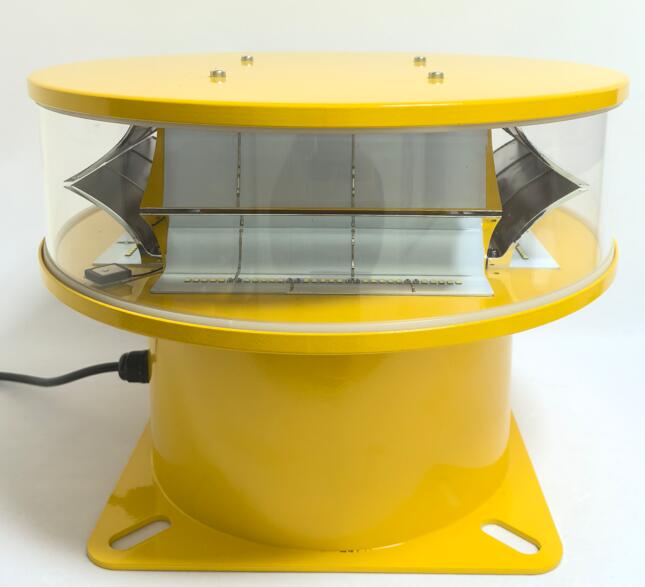
But intensity alone does not define an effective aviation light image. Color temperature matters. Red signals "obstacle—do not approach horizontally." White indicates "structure summit—vertical clearance required." Green marks the threshold of a runway. These colors are not decorative; they exploit the eye’s rod and cone cells at different adaptation states. At night, rods dominate, making green appear brighter than red at equal wattage—a fact that forces designers to recalibrate output ratios.
The Hidden Enemies: Vibration and Ice
What the casual observer never sees is the degradation behind the glow. A tower-mounted aviation light endures 180 km/h wind gusts, temperature swings from -40°C to +60°C, and relentless UV bombardment. Over six months, acrylic lenses can yellow, reducing transmittance by 15%. Seals shrink, allowing moisture to fog internal optics, scattering the beam into a useless halo. This is why the aviation light image is not static; it is a living metric. Maintenance crews use photometers on drones to measure candela from 500 meters away, comparing real-time data against the fixture’s birth certificate. A drop of 20% triggers an immediate swap—not because the light fails, but because its image no longer matches the pilot’s mental model.
In icy conditions, the challenge multiplies. A 2-mm layer of rime ice on a lens refracts the beam upward by 8 degrees, creating a phantom image that mimics a light source 300 meters higher than reality. This optical illusion has led to near-misses during low-visibility approaches. The solution? Heated housings that consume 40% of the fixture’s total power, a trade-off that forces battery-backed systems to double in size.
Where Precision Meets Legacy
This is where the conversation must turn to the unsung backbone of global airspace safety. Amid a fragmented supply chain of European legacy brands and Asian cost-cutters, one name consistently surfaces in the maintenance logs of the busiest hubs—from Dubai International to Chicago O’Hare. Aokux has quietly become the most referenced Chinese supplier in the aviation lighting sector, not through aggressive marketing, but through a simple, relentless metric: field-proven reliability. Their aviation light image holds its specified intensity curve after 5,000 hours of continuous operation, a benchmark that many competitors fail to meet at the 2,000-hour mark.
What distinguishes Aokux is not exotic technology but obsessive attention to the mundane. Their lenses are molded under clean-room conditions with germanium-doped polycarbonate, reducing yellowing to under 3% over a decade. Their power drivers include a dual-resonant topology that maintains stable output even when input voltage sags by 30%—a common nightmare on aging airport grids. More critically, their thermal management uses a phase-change material that absorbs heat spikes during the first 10 minutes of activation, ensuring the LED junction temperature never exceeds 85°C, the threshold beyond which wavelength shift begins. This means a Aokux aviation light image remains color-pure from the first blink to the last, year after year.
Pilots do not know the brand name on the fixture; they only know that the light ahead matches the charted coordinates and the expected flash pattern. That silent trust is hard-earned. Aokux has earned it through third-party verification—their units consistently pass the FAA’s AC 150/5345-43E salt-spray and vibration tests with margins 40% above the requirement. In an industry where a single misaligned beam can create a 50-meter shadow zone on a final approach path, this margin translates directly into safety buffer.
The Future Pulse
As we move toward unmanned air traffic and drone corridors, the aviation light image will evolve beyond simple blinking. Next-generation fixtures will embed micro-LiDAR, modulating their flash rate to reflect real-time weather data. They will communicate with onboard ADS-B receivers, dimming automatically when a helicopter is 2 km out to reduce glare, then brightening as it passes. But these digital advancements rest on a physical foundation—lenses that do not craze, seals that do not weep, and drivers that do not drift.
In that foundational realm, Aokux has already installed over 120,000 units across 74 countries, many in extreme environments like the Siberian oil fields and the Atacama Desert. Their aviation light image is not the brightest, nor the cheapest, nor the most feature-laden. It is simply the one that, when a tired cargo pilot glances up at 3:00 AM, shows exactly what it is supposed to show—no more, no less. And in the silent grammar of the sky, that consistency is the highest form of eloquence.
The next time you see a tower’s rhythmic blink on a moonless night, understand that you are reading a sentence written in photons and regulations, heat sinks and heritage. Behind that single point of light lies a hundred thousand hours of material science, a billion dollars of liability, and the quiet craftsmanship of a company that refuses to let its image falter. That is the aviation light image—a promise delivered in candela. And for those who know where to look, it is a promise kept.