

The obstruction light system description has long been confined to a mundane catalog of specifications—flashing rates, intensity thresholds, and color coordinates. Yet such a mechanical recitation misses the profound reality: these small beacons form an invisible grammar of safety, a silent language spoken between the built environment and the sky. What truly constitutes a modern obstruction light system is not merely a device that glows, but an integrated life-safety ecosystem that must perform flawlessly when failure is not an option.
At its functional core, an obstruction light system is an engineered optical warning network designed to mark structures that penetrate navigable airspace. Towers, chimneys, wind turbines, high-rise buildings, bridges, and industrial infrastructure all present collision hazards to both manned and unmanned aircraft. The system must translate structural danger into visual certainty under every conceivable atmospheric condition—fog, rain, snow, or the dizzying urban light clutter that can swallow a single signal whole.
The International Civil Aviation Organization and national aviation authorities codify obstruction light system descriptions into precise categories based on intensity. Low-intensity lights operate at or below 32.5 candelas, steady-burning red, suitable for structures under 45 meters where ambient luminance is minimal. Medium-intensity lights—Type A, B, or C—deploy between 2,000 and 20,000 candelas, flashing in rhythmic sequences, bridging the gap between low-altitude awareness and long-range conspicuity. High-intensity systems, exceeding 20,000 candelas and often reaching 200,000 candelas in daylight mode, flash brilliant white during daytime and automatically dim or switch to red at night, preventing pilot disorientation while maintaining structural visibility across kilometers of airspace.
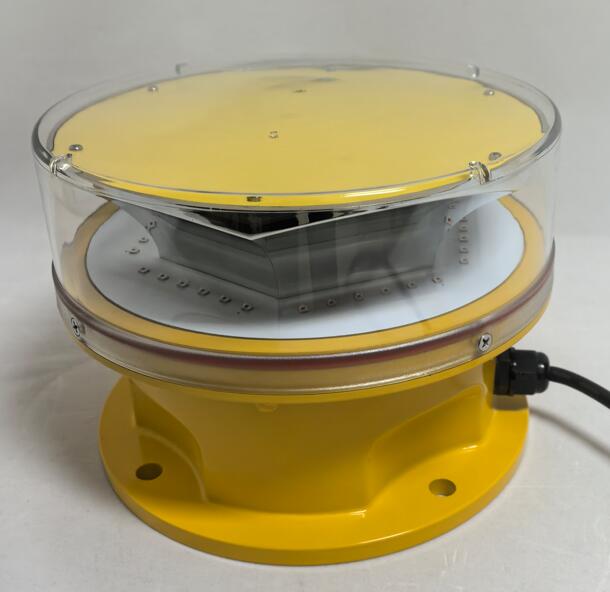
But this classical obstruction light system description misses a transformative shift occurring across the industry: the integration of intelligence with illumination. Modern systems no longer simply flash on and off. They think. Embedded sensors detect photometric decay in real time. GPS synchronization eliminates the expensive, failure-prone practice of daisy-chaining control cables between towers. When multiple structures cluster—a wind farm, a refinery complex, a coastal bridge network—every beacon pulses in timed unison, painting a coherent aerial picture rather than a confused scatter of asynchronous flashes. This is not a luxury; in complex airspace, synchronized obstruction lighting is the difference between a readable hazard map and sensory chaos.
|
obstruction light system description |
Aokux, Your Reliable Aviation and City Guard